
Nuclear weapons—the deadliest tools ever created—are held by only a handful of nations, but their presence shapes the entire global power structure. Ever wondered how these countries got the bomb in the first place?
Let’s break down the nine nuclear-armed countries, the journey each took, and the current state of global nuclear power.
🌍 1. United States 🇺🇸
First test: 1945 (Trinity Test)
Weapons today: ~5,244 warheads (2024 estimate)
How they got it:
The U.S. led the world into the nuclear age with the Manhattan Project during World War II, assembling top scientists and massive resources. They dropped two bombs on Japan (Hiroshima and Nagasaki), forever altering modern warfare.
🐻 2. Russia (formerly USSR) 🇷🇺
First test: 1949
Weapons today: ~5,889 warheads
How they got it:
The Soviet Union developed its bomb as a direct counter to the U.S., with substantial espionage from the Manhattan Project playing a role. The Cold War arms race followed, ballooning their stockpile.
🦁 3. United Kingdom 🇬🇧
First test: 1952
Weapons today: ~225 warheads
How they got it:
Britain worked with the U.S. on early atomic research but was later excluded. Determined, they independently built their own bomb using domestic research and testing in Australia.
🇫🇷 4. France
First test: 1960
Weapons today: ~290 warheads
How they got it:
France pursued nuclear independence under Charles de Gaulle. It refused to rely on allies and developed its arsenal through tests in the Algerian desert and later the Pacific.
🐉 5. China 🇨🇳
First test: 1964
Weapons today: ~410+ warheads (rapidly growing)
How they got it:
China’s “Project 596” was powered by Soviet assistance until the Sino-Soviet split. Afterward, China went fully independent, testing its first bomb at Lop Nur.
🕍 6. Israel 🇮🇱 (undeclared)
First test (alleged): 1979 (Vela Incident)
Weapons today: Estimated 90–200
How they got it:
Israel has never officially confirmed having nukes. It likely developed them in the 1960s, with help from France and clandestine operations, including alleged uranium diversion from the U.S. (NUMEC case).
🕌 7. India 🇮🇳
First test: 1974 (“Smiling Buddha”)
Weapons today: ~170 warheads
How they got it:
India developed nuclear technology for peaceful purposes post-independence. However, tensions with China and Pakistan led to weaponization. Despite global pressure, India remained outside the NPT and tested again in 1998.
☪️ 8. Pakistan 🇵🇰
First test: 1998
Weapons today: ~170 warheads
How they got it:
Pakistan’s program was a response to India. Led by Dr. A.Q. Khan, Pakistan developed its weapons via uranium enrichment, aided by nuclear smuggling networks and technology from Europe and China.
🌱 9. North Korea 🇰🇵
First test: 2006
Weapons today: Estimated 30–40 warheads
How they got it:
North Korea signed the Nuclear Non-Proliferation Treaty (NPT) but later withdrew. Using nuclear reactors and clandestine enrichment, it built bombs despite sanctions and global opposition.
❌ Nations That Gave Up or Were Disarmed
- South Africa – Built 6 bombs in the ’80s, dismantled all voluntarily before apartheid ended.
- Kazakhstan, Ukraine, Belarus – Inherited USSR nukes but gave them up to Russia in the 1990s under international treaties (Budapest Memorandum).
📜 What Is the NPT?
The Nuclear Non-Proliferation Treaty (1968) allows only five recognized nuclear powers: USA, UK, Russia, China, and France. India, Pakistan, Israel, and North Korea are outside it.
⚠️ The Controversies and Risks
- A.Q. Khan Network: Spread nuclear secrets to Iran, Libya, and North Korea.
- Double Standards: Critics argue that the NPT is unfair to non-Western countries.
- Nuclear Modernization: The U.S., Russia, and China are updating arsenals, reigniting arms race fears.
- “Doomsday Clock”: Set at 90 seconds to midnight in 2024, mainly due to nuclear tensions.
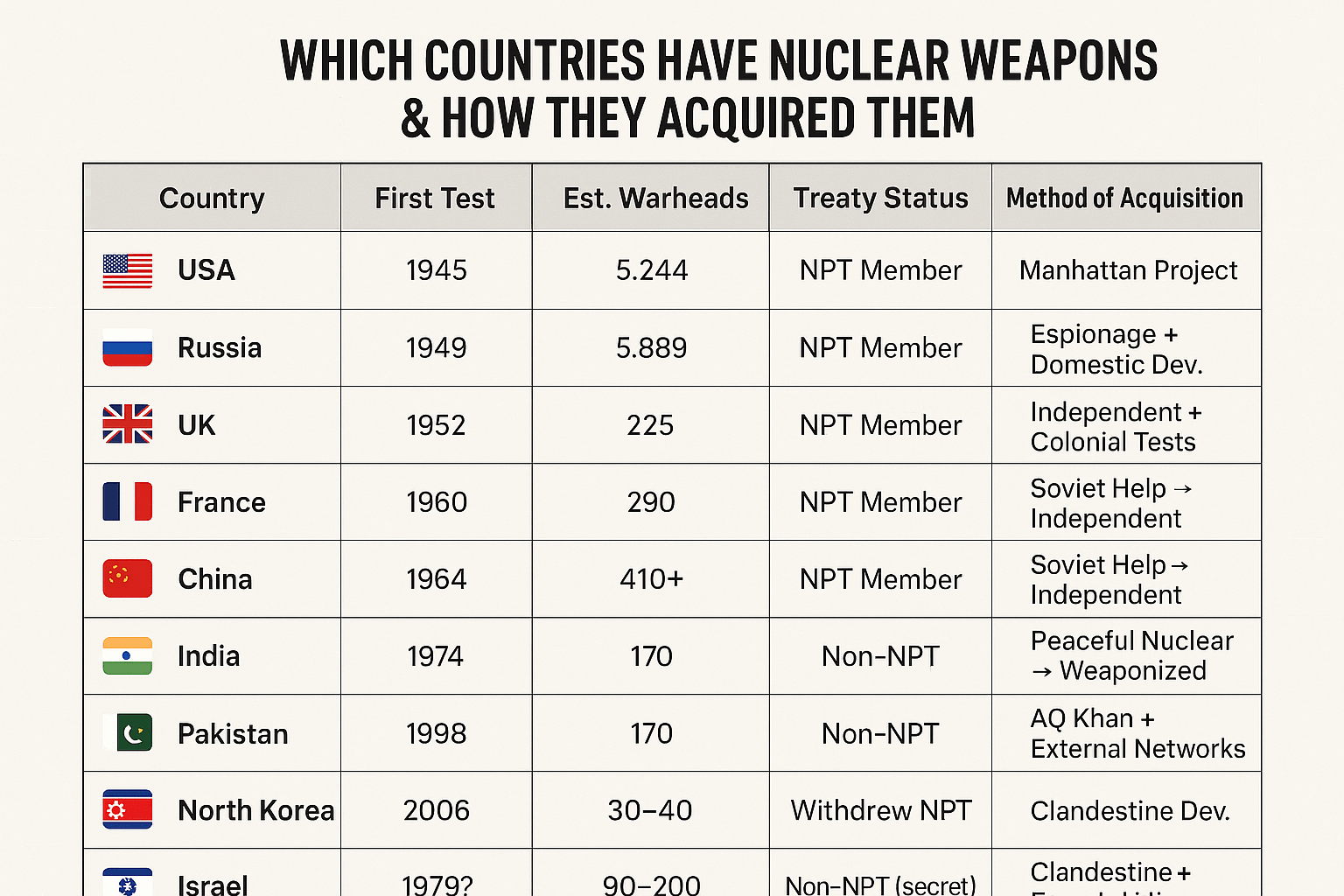
📊 Infographic: Global Nuclear Arsenal at a Glance
[Infographic Concept – Can be added as image or embedded on your blog]
| Country | First Test | Est. Warheads | Treaty Status | Method of Acquisition |
|---|---|---|---|---|
| 🇺🇸 USA | 1945 | ~5,244 | NPT Member | Manhattan Project |
| 🇷🇺 Russia | 1949 | ~5,889 | NPT Member | Espionage + Domestic Dev. |
| 🇬🇧 UK | 1952 | ~225 | NPT Member | Domestic Dev. post-WWII |
| 🇫🇷 France | 1960 | ~290 | NPT Member | Independent + Colonial Tests |
| 🇨🇳 China | 1964 | ~410+ | NPT Member | Soviet Help → Independent |
| 🇮🇳 India | 1974 | ~170 | Non-NPT | Peaceful Nuclear → Weaponized |
| 🇵🇰 Pakistan | 1998 | ~170 | Non-NPT | AQ Khan + External Networks |
| 🇰🇵 N. Korea | 2006 | ~30–40 | Withdrew NPT | Clandestine Dev. |
| 🇮🇱 Israel | 1979? | ~90–200 | Non-NPT (secret) | Clandestine + French/U.S. Cooperation |
🧠 Final Thoughts
The nuclear club is exclusive—and dangerous. While nuclear deterrence has arguably kept world wars at bay, it also keeps humanity on the edge of annihilation.
As we move forward, will nations disarm—or will the next new entrant emerge?
🔍 Want more deep dives like this?
Check out AmanBlogs.com – your window to the world’s most mysterious, controversial, and intriguing stories.
“Uncovering the world’s secrets, one post at a time.”