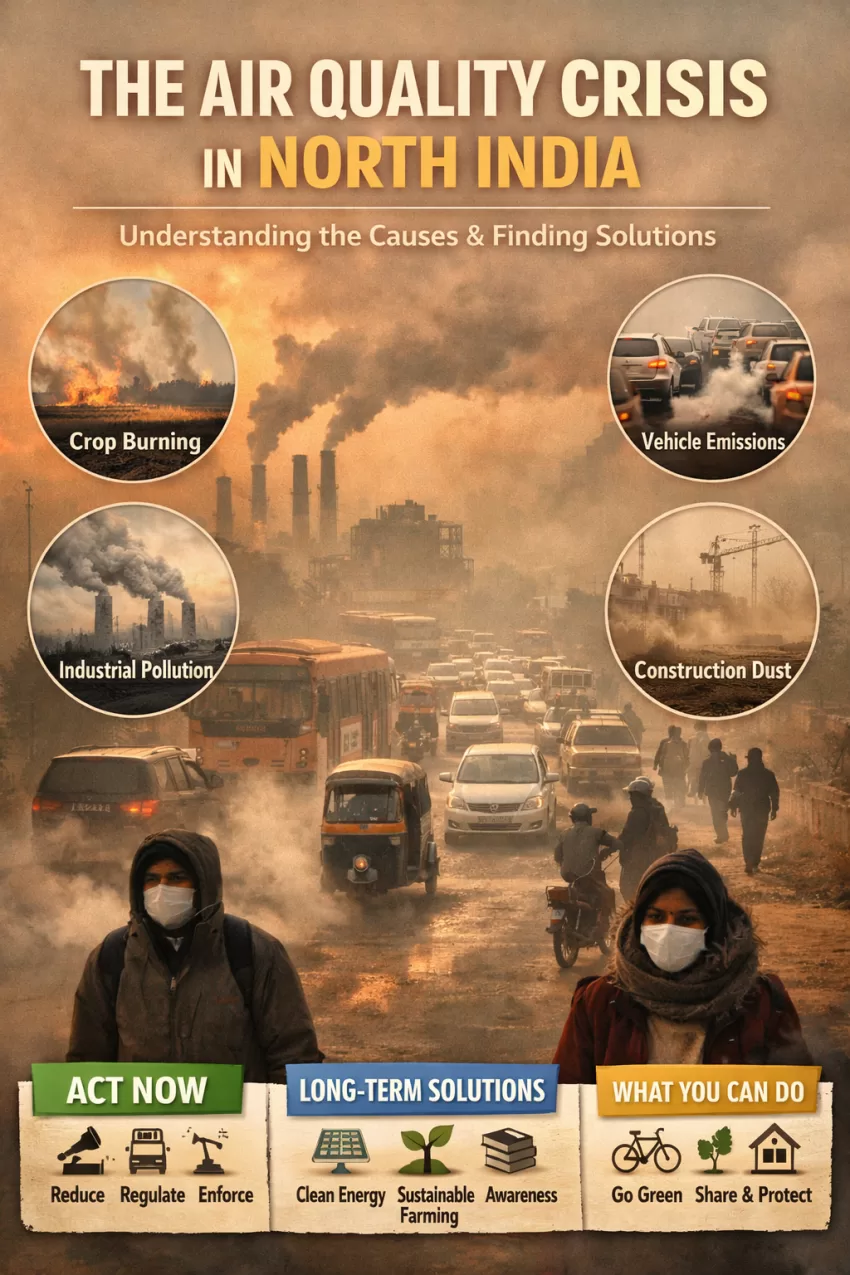
Why the haze won’t just disappear, what’s driving it, and what we must do next
North India’s skies have been dressing in a dull gray far too often. The Air Quality Index (AQI) in cities and towns from Delhi to Chandigarh to Lucknow has repeatedly slipped into the “unhealthy” and “severe” zones over recent years. This isn’t just a seasonal nuisance with foggy mornings and reduced visibility. It’s a public health alarm bell ringing for change—swift, systemic, and sustained.
What’s Behind the Worsening AQI?
The swirl of smog is not accidental. Several human and environmental factors intertwine to throttle the air we breathe.
1. Crop Burning in Neighboring States
Every post-harvest season, fields in Punjab and Haryana become bonfire sites for leftover stubble. These fires spew massive amounts of particulate matter (PM2.5 and PM10) into the air. Winds then carry this toxic cocktail toward cities, pushing AQI into dangerous levels.
2. Vehicular Exhaust on Overloaded Roads
The number of vehicles in urban north India has ballooned. More cars, fewer emission controls, and congested highways mean more nitrogen oxides, hydrocarbons, and particulate pollutants in the air.
3. Industrial Emissions
Manufacturing units, brick kilns, power plants, and factories release a mix of sulphur and nitrogen compounds. In areas without rigorous monitoring or clean tech standards, pollution pours unchecked.
4. Construction and Dust
Rapid urban growth comes with construction sites and dirt roads—huge sources of suspended dust. Without adequate water sprinkling and regulation, dust alone can drive up AQI substantially.
5. Topography and Weather Patterns
During winter, cooler temperatures and calm winds trap pollutants near the surface—a phenomenon called “temperature inversion”—leading to stagnant smog that lingers for days.
Why This Matters: The Human Cost
Air isn’t just invisible background noise. Polluted air affects lungs, hearts, and lives:
- Respiratory illnesses like asthma and bronchitis spike.
- Cardiovascular risks rise, especially among the elderly and children.
- Reduced productivity as people fall sick or avoid outdoor work.
- Long-term health burden on families and health systems.
The air quality issue isn’t confined to statistics or charts—it’s a daily reality for millions.
Immediate Actions: What the Need of the Hour Looks Like
Policy and Enforcement
- Crack down on illegal crop burning. Provide incentives for farmers to adopt alternatives like happy seeders and mulchers.
- Strengthen vehicle emission standards and monitoring. Enforce timely pollution checks and introduce cleaner fuel norms.
- Control industrial emissions. Make clean tech adoption mandatory and penalize violators without delay.
- Dust control on construction sites. Mandate water spraying, green nets, and strict fines for violations.
Urban Planning for Cleaner Air
- Integrated traffic management and expansion of public transport to reduce reliance on private vehicles.
- Creation of green belts, street trees, and pollution-absorbing landscaping throughout city corridors.
Long-Term Solutions: A Breathable Tomorrow
The crisis can’t be fixed with drones and smog towers alone. Sustainable change needs strategic thinking:
1. Clean Energy Transition
Encouraging solar, wind, and other renewables can cut dependence on fossil fuels. Every rooftop solar panel is a tiny step toward cleaner air.
2. Reimagined Agriculture
Government-led programs to subsidize zero-burn techniques, better irrigation, and crop diversification can reduce the reliance on stubble burning.
3. Smart Cities and Smart Policies
Air quality sensors, real-time monitoring, data-driven decision making, and transparent pollution reporting—all can make communities proactive rather than reactive.
4. Education & Awareness
Schools, media, and community groups must unite to spread awareness about pollution’s health impacts and preventive measures.
What Residents Can Do: Everyday Choices That Add Up
Yes, the problem is broad—and yes, your actions matter.
At Home
- Use air purifiers in bedrooms, especially for children and elders.
- Switch to clean cookstoves and energy-efficient appliances.
- Reduce burning of waste; compost instead.
On the Road
- Choose public transport, cycling, or walking whenever possible.
- Carpool to work; consider ride-sharing schemes.
- Maintain your vehicle to reduce emissions.
In the Community
- Plant trees and support local green initiatives.
- Advocate for cleaner policies with local representatives.
- Share air quality updates and health advisories with neighbors.
Final Thought
North India’s air is an invisible tapestry woven through every breath we take. When that tapestry turns gray, the impact is tangible in classrooms, clinics, and living rooms. It’s both a crisis and an opportunity—one that calls for thoughtful policy, community action, and everyday choices that help the air we share become cleaner again.