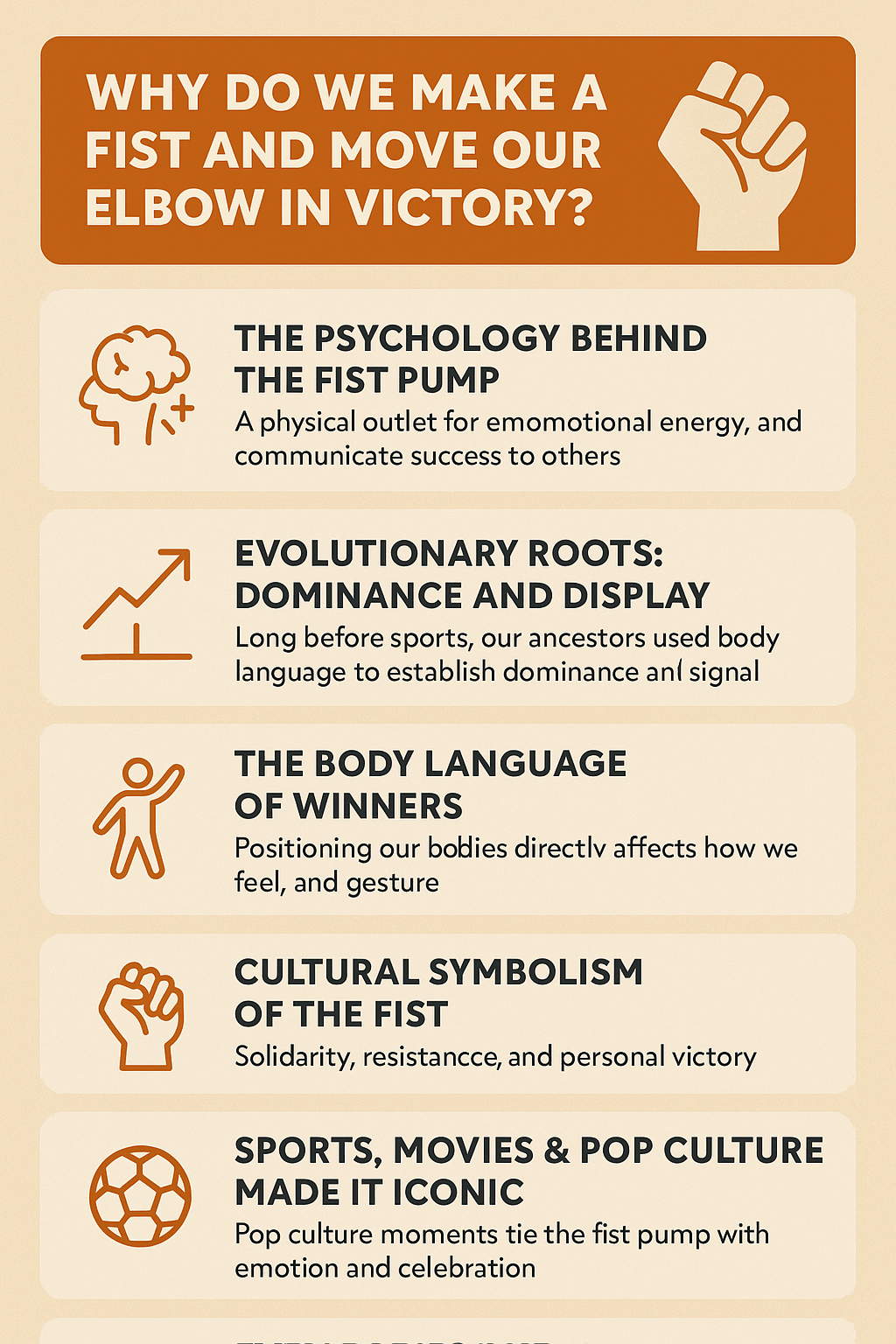
The Psychology, Evolution, and Hidden Meaning Behind the Iconic Gesture
Have you ever found yourself clenching your fist, bending your elbow, and punching the air with a burst of “Yes!” after a personal win?
From athletes on the field to students finishing an exam, this instinctive fist pump is a universal expression of victory—but have you ever stopped to wonder why we do it?
Let’s explore the fascinating science, psychology, and evolution behind this powerful gesture.
🧠 1. The Psychology Behind the Fist Pump
Psychologists agree that the fist pump is more than a habit—it’s a physical outlet for emotional energy. When we achieve something, adrenaline spikes, and the body looks for a release.
The gesture helps to:
- Vent built-up tension and excitement,
- Reinforce a sense of accomplishment, and
- Visibly communicate success to others.
The movement is often accompanied by a dopamine surge—the “reward chemical” in your brain—creating a feedback loop of motion → emotion → satisfaction.
🧬 2. Evolutionary Roots: Dominance and Display
Long before humans played sports or gave TED Talks, our ancestors used body language to establish dominance and signal victory. In both humans and animals, expanding the body (like raising arms or puffing out the chest) signals power and success.
The fist pump:
- Mimics a punch or upward strike—a primal display of strength,
- Expands the body vertically and outwardly,
- Asserts a kind of territorial confidence.
In essence, this motion is a non-verbal roar—a throwback to when survival depended on how loudly and clearly you could show dominance.
🧍♂️ 3. The Body Language of Winners
Social psychologist Dr. Amy Cuddy, known for her work on power poses, found that how we position our bodies directly affects how we feel. The classic fist pump is a dynamic version of this: a quick, explosive movement that boosts confidence and makes the body feel more powerful.
You’ll often see:
- A single fist thrust upward,
- Both fists raised,
- A jump with the elbow bent and fist clenched,
- Or repeated “mini-pumps” of the elbow like a piston.
It’s not just for show—it’s your brain and body syncing to broadcast confidence.
💪 4. Cultural Symbolism of the Fist
Over time, the fist has taken on deep symbolic meanings:
- ✊ In protests, it shows solidarity and resistance.
- ✊ In politics, it’s a rallying symbol of strength.
- ✊ In sports, it’s the seal of personal victory.
The elbow movement adds force and personality, giving the gesture a narrative—as if you’re punching through your obstacles.
The combination says: “I’ve fought. I’ve earned this. I win.”
⚽ 5. Sports, Movies & Pop Culture Made It Iconic
From Cristiano Ronaldo’s mid-air fist pose to Tiger Woods’ iconic single-arm pump, athletes have brought the gesture into global visibility. In Rocky, Sylvester Stallone running up the steps and raising his fists is forever etched into pop culture.
These moments reinforce the association between body movement and emotional release, making the fist pump a gesture of both personal and shared celebration.
👶 6. Even Babies and Blind Children Do It
This might surprise you: Even very young children display early forms of the victory gesture.
When a baby finally grabs a toy or stacks blocks successfully, they often:
- Raise their arms,
- Clench their fists,
- Or wave their limbs in excitement.
This shows that celebratory body language is deeply ingrained, not learned.
Even more striking: Blind children, who have never seen anyone perform a victory pose, instinctively raise their fists and arms when they win or succeed. Researchers observed this in blind athletes at the Paralympic Games—celebrating just like their sighted peers.
This proves that the fist pump is biological, not cultural. It’s a built-in human response to triumph.
🔁 Final Thought: One Gesture, a Thousand Years of Meaning
The fist pump with a bent elbow isn’t just a gesture—it’s a full-body declaration of emotion, strength, and pride. It’s a victory dance encoded in our DNA. From babies to boxers, boardrooms to battlefields, it says the same thing:
“I did it.”
So the next time you instinctively pump your fist in triumph, remember—you’re not just celebrating the moment. You’re participating in an ancient, universal language of human victory.
Loved this deep dive?
Explore more strange, powerful, and mind-opening topics at AmanBlogs.com — where curiosity wins every time.
👉 From body language to world mysteries—we make the unexplained, explained.