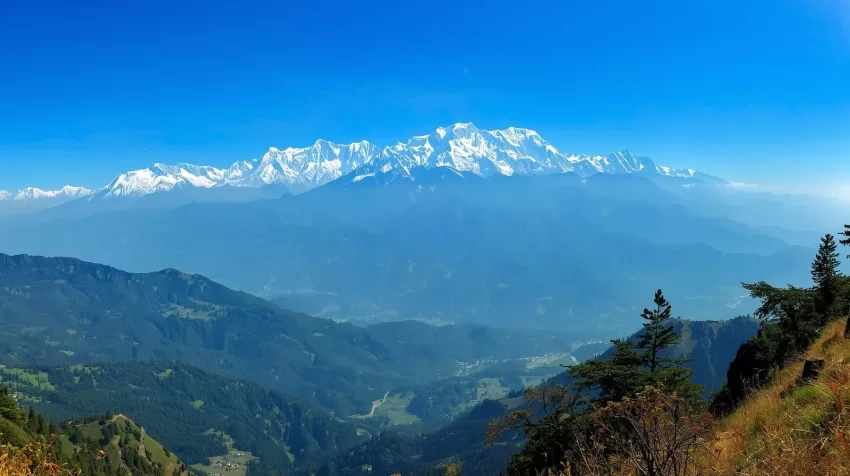
If you’ve ever been to Kausani — the “Switzerland of India,” as Mahatma Gandhi once called it — you know the anticipation that builds as you climb its winding roads. The small Uttarakhand town, perched at about 6,000 feet, promises postcard views of the mighty Himalayan peaks: Trishul, Nanda Devi, and Panchachuli stretching across the horizon like a painting.
But for many first-time visitors who arrive between March and October, there’s often a tinge of disappointment. The valleys are green, the air is pleasant, and the hills are alive with birds and pine-scented breezes — but the snow peaks seem to have vanished. The grand white wall of the Himalayas that everyone talks about is nowhere to be seen.
So why do the Himalayas disappear for most of the year?
1. The Summer Haze and Dust Layer
The simplest reason is atmospheric haze. As the plains of northern India heat up in summer, warm air currents rise and carry with them vast amounts of dust, moisture, and smoke. These particles scatter sunlight and create a hazy veil that blocks visibility, especially for long distances.
From Kausani, the major Himalayan peaks are about 100 to 150 kilometers away as the crow flies. That means even a thin layer of haze in the lower atmosphere can easily obscure them. On many days, the haze forms a thick, milky curtain that blends with the sky, completely hiding the snowline behind it.
Even after the monsoon arrives, visibility doesn’t improve much. The heavy moisture in the air forms cloud cover and fog, which may bring lush greenery to the hills but also keep the peaks out of sight.
2. The Role of Humidity and Temperature Inversion
During warmer months, high humidity levels lead to water vapor hanging in the air. This not only adds to the haze but also reflects sunlight, washing out distant details.
Another factor is temperature inversion — when cooler air gets trapped near the ground under a layer of warmer air. This prevents air circulation and keeps dust and pollutants suspended for longer. The result? A persistent layer of smog that blurs the otherwise crisp Himalayan outlines.
3. The Monsoon Months: Clouds Take Over
From June to September, Kausani experiences monsoon rains. While the forests turn vibrant green and streams gush with new life, the skies remain mostly overcast. The peaks are hidden behind thick clouds almost every day. Even locals will tell you — “The mountains are sleeping now; they’ll wake up in winter.”
4. Winter: The Season of Clarity and Magic
Then comes November, and something magical happens. The monsoon dust settles, the skies dry out, and the crisp mountain air returns. The humidity drops dramatically, and visibility stretches for hundreds of kilometers.
From November to February, the Himalayas make their grand reappearance. The peaks glow silver under the morning sun, and as the day progresses, they shift hues — from golden to blush pink to icy blue. On a clear winter morning, the view from Kausani can leave even seasoned travelers speechless.
Winter not only brings clearer skies but also fresh snowfall on the high ranges, making them look whiter and sharper than ever. The cold may bite a little, but it’s a small price to pay for those unforgettable Himalayan vistas.
5. When to Visit for the Best Views
If your main goal is to see the snow peaks, plan your visit between late October and February. The early mornings — just after sunrise — offer the clearest, most breathtaking views. By 9 or 10 a.m., as the air warms slightly, a thin mist may start to form again, softening the view.
So, carry a warm jacket, wake up early, and head to the Kausani viewpoint or your hotel balcony with a cup of steaming tea. As the first light hits Trishul and Nanda Devi, you’ll understand why people fall in love with this place.
In short: The Himalayas don’t really vanish — they’re just hiding behind summer’s haze. But when winter sweeps through Uttarakhand, the air turns crystal clear, and the mountains return in all their glory — standing tall, silent, and eternal.