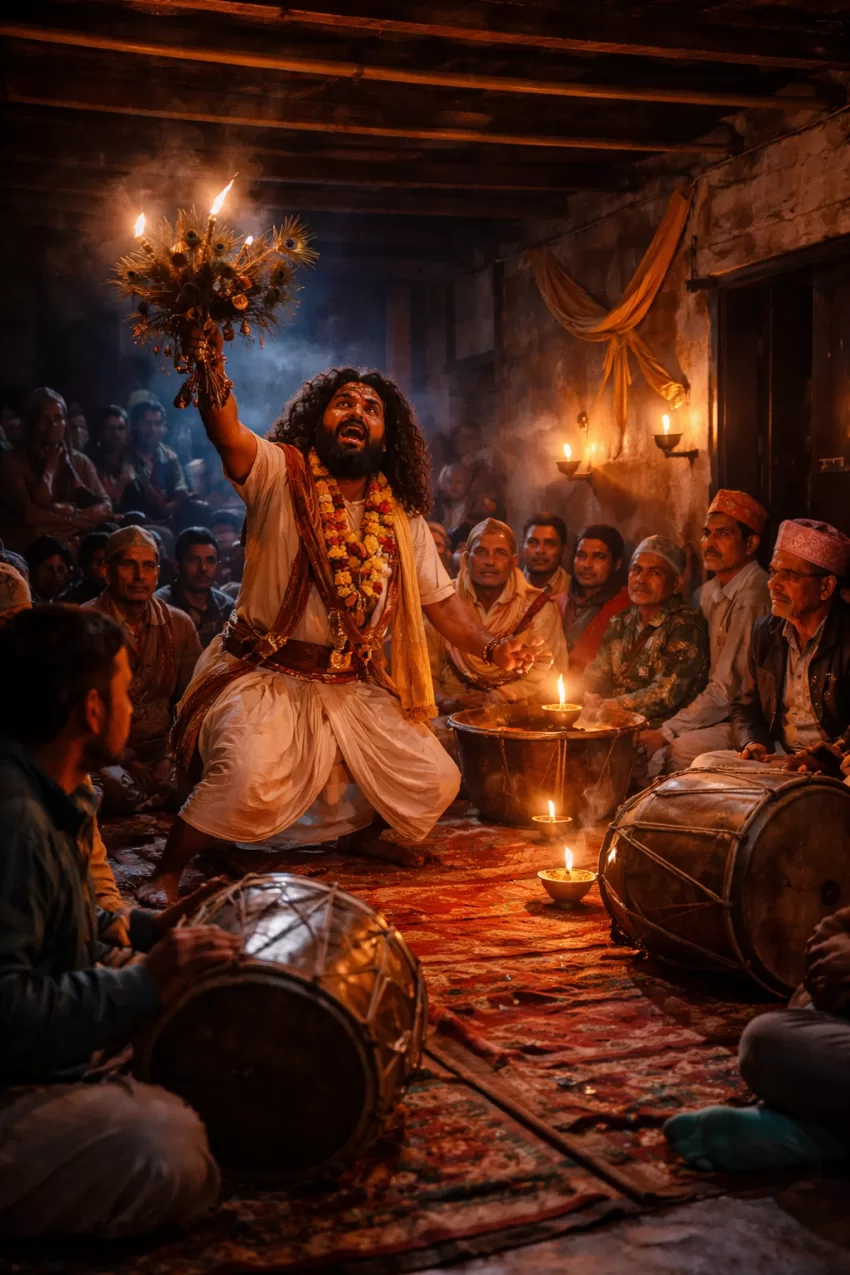
In the quiet mountain villages of Uttarakhand, nights sometimes refuse to sleep. Oil lamps flicker, drums begin to speak, and voices rise not to entertain, but to awaken. This is Jagar, one of the most powerful and living folk traditions of the central Himalayas, where gods are not worshipped from a distance but invoked, questioned, and experienced.
The word Jagar comes from the Sanskrit root jag, meaning “to awaken”. In essence, Jagar is a ritual of awakening local deities, ancestral spirits, and divine forces, inviting them to descend into the human realm. Unlike temple rituals bound by rigid structure, Jagar is fluid, emotional, and deeply personal. It is both prayer and conversation, devotion and dialogue.
The Soul of the Mountains
Jagar is primarily practiced in Kumaon and Garhwal regions, often in village homes rather than temples. It is performed during moments of crisis or uncertainty, such as unexplained illness, recurring misfortune, land disputes, or when guidance is sought from the divine. The belief is simple yet profound: when human understanding fails, the gods must be called to speak.
At the heart of the ritual is the Jagariya, the singer who narrates long ballads that trace the lineage, deeds, and journeys of the deity being invoked. These songs are not mere music. They are oral scriptures, passed down generations, preserving local history, folklore, and cosmology.
Accompanying the Jagariya is the steady rhythm of traditional instruments like the dhol and damau. As the night deepens, the beats intensify, weaving an atmosphere that feels charged and alive.
The Moment of Possession
The most intense moment of a Jagar occurs when the deity is believed to enter the body of a medium, known as the Dangariya or Pashwa. The transformation is unmistakable. The voice changes, movements become forceful, and the presence feels larger than the person themselves.
Villagers gather around, asking questions, seeking justice, blessings, or explanations. The deity responds directly. There is no intermediary, no polished sermon. What emerges is raw truth, sometimes comforting, sometimes unsettling, but always deeply respected.
In a world increasingly filtered through screens and logic, Jagar remains unapologetically mystical.
More Than a Ritual
Jagar is not theatre, superstition, or performance art, though to an outsider it may appear so. For the people of Uttarakhand, it is a social and spiritual institution. It reinforces moral order, resolves conflicts, and reminds communities of their roots and responsibilities.
Equally important is its role as a cultural archive. The ballads sung during Jagar preserve stories of forgotten kings, village deities, and regional heroes that exist nowhere in written form.
Jagar in the Modern Age
Today, Jagar stands at a fragile crossroads. Modern education, migration, and urban lifestyles have reduced its frequency. Yet, it has not disappeared. In fact, there is a quiet revival, with cultural researchers, musicians, and younger generations rediscovering its depth and relevance.
Jagar teaches patience in a hurried world, listening in a noisy age, and humility before forces larger than ourselves.
In the mountains of Uttarakhand, when the drums beat through the night and voices call into the dark, it is a reminder that some traditions are not meant to fade. They are meant to awaken us.