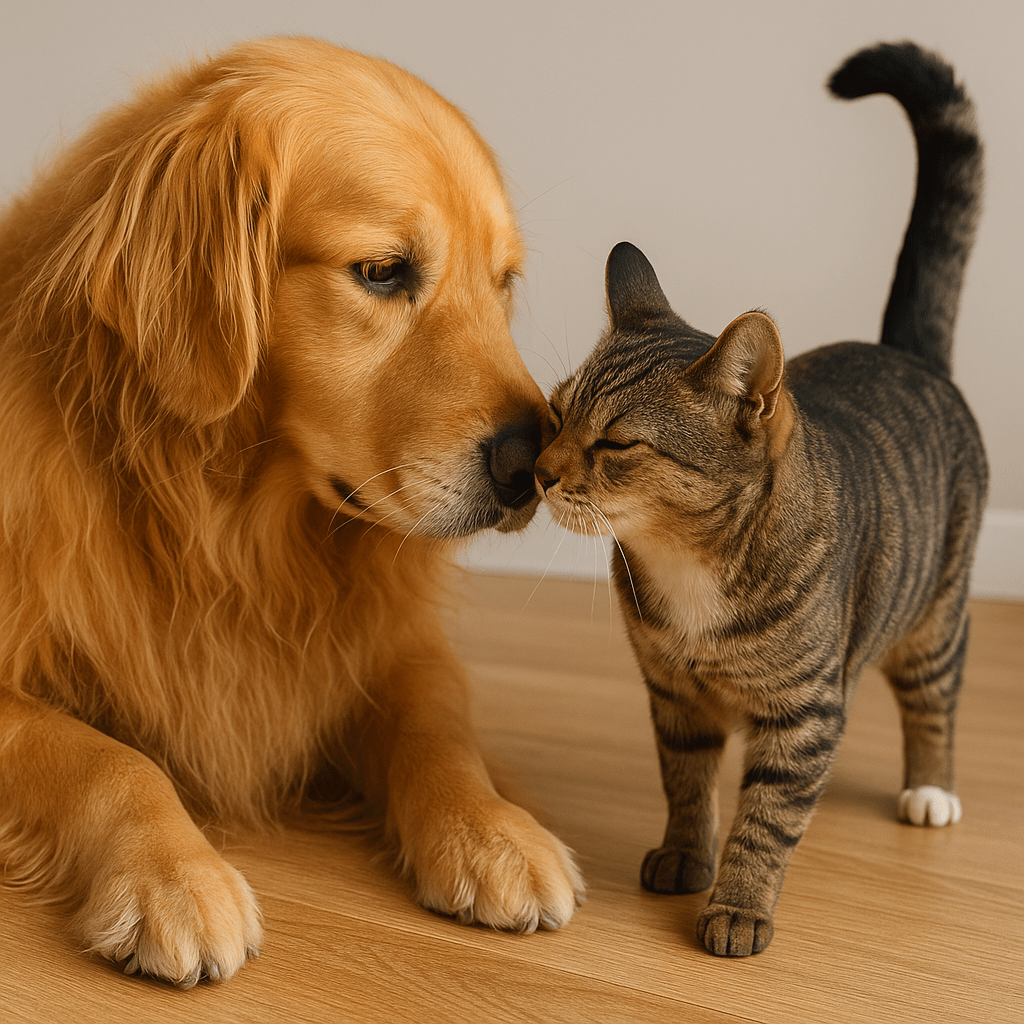
Have you ever wondered what really goes on between your dog and cat when they stare each other down in the hallway or play-fight in the living room? Science reveals that these two very different species do, in fact, communicate—just not the way you might expect.
🐾 The Misunderstood Frenemies
Dogs and cats have long been cast as natural enemies, but studies suggest that’s more stereotype than science. In homes where dogs and cats are raised together, 64% of pet owners report that their pets play together regularly, according to a study published in Behavioural Processes (2018).
Still, their communication styles are fundamentally different:
- Dogs are social pack animals that rely heavily on vocal cues and body language.
- Cats, on the other hand, are solitary hunters by nature, using subtle facial expressions, tail movements, and scent marking.
So how do these species with such opposing instincts manage to get along?
🔊 1. Vocalization: Bark vs. Meow
Dogs bark, growl, and whine. Cats meow, purr, and hiss. But when they live together, something fascinating happens—they adjust their vocal cues based on the other’s reactions.
- Dogs often whine softly or bark in short bursts when trying to play with cats.
- Cats, in turn, may use a “chirping” sound—a friendly, high-pitched trill typically reserved for kittens or humans.
📊 Data Insight: A 2021 study by the University of Lincoln in the UK found that over 70% of dogs and cats in multi-pet households exhibit modified vocal behavior to accommodate the other species.
🐕🦺🐈 2. Body Language: Tail Talk and Earspeak
Body language is a critical bridge between these species:
| Signal | Dogs Interpret As | Cats Interpret As |
|---|---|---|
| Tail high and wagging | Friendly and playful | Threatening or dominant |
| Ears flat | Fear or submission | Aggression or annoyance |
| Belly exposed | Submission/playfulness | Defensiveness (for cats) |
👉 Key Insight: Misinterpretation is common. For instance, a wagging dog tail is inviting, but to a cat, it can signal danger or irritation. That’s why early introductions and observation-based learning are vital.
👃 3. The Role of Scent: Invisible Messaging
While humans overlook this, dogs and cats are both scent-driven. They “speak” through scent marking—rubbing, sniffing, or rolling.
- Cats use pheromones from glands in their cheeks, paws, and forehead.
- Dogs rely on urine marking, anal gland scents, and body odor.
🐾 Cool Fact: A study in Applied Animal Behaviour Science (2019) showed that 85% of cohabiting pets share sleeping areas and objects, which facilitates scent bonding and mutual recognition.
💡 4. Social Learning: Pets Mimic Each Other
Over time, pets in multi-species homes learn from each other:
- Dogs learn to tolerate or even use more subtle, cat-like gestures.
- Cats can become more outgoing and interactive, adopting dog-like play behavior.
📈 Behavioral Pattern Data: In a survey of over 1,200 pet owners, 48% reported that their cats learned to follow their dogs outdoors or to the door when someone rings the bell, mimicking social cues.
🧠 5. Emotional Intelligence: Recognizing Each Other’s Moods
Perhaps the most mysterious form of communication is the emotional attunement pets develop. In households where pets are bonded:
- Dogs often approach cats when they’re stressed or ill.
- Cats may groom or sleep near dogs during storms or loud noises.
This implies a level of emotional intelligence and cross-species empathy not fully understood by science—but increasingly documented through anecdotal and observational studies.
🔮 Conclusion: More Than Meets the Eye
Dogs and cats may not “speak” the same language, but their ability to understand, adapt, and connect across species boundaries is nothing short of remarkable. With time, patience, and mutual respect, these so-called rivals can become lifelong companions.
So next time you see your cat gently headbutt your dog, or your dog lay quietly beside your cat during a thunderstorm—know that they’re saying more than we can ever hear.
🐶🐱 Bonus Tip for Pet Owners
Want your dog and cat to get along better?
- Introduce them early (under supervision)
- Let them eat separately
- Provide escape spaces for your cat
- Reward calm behavior from both sides