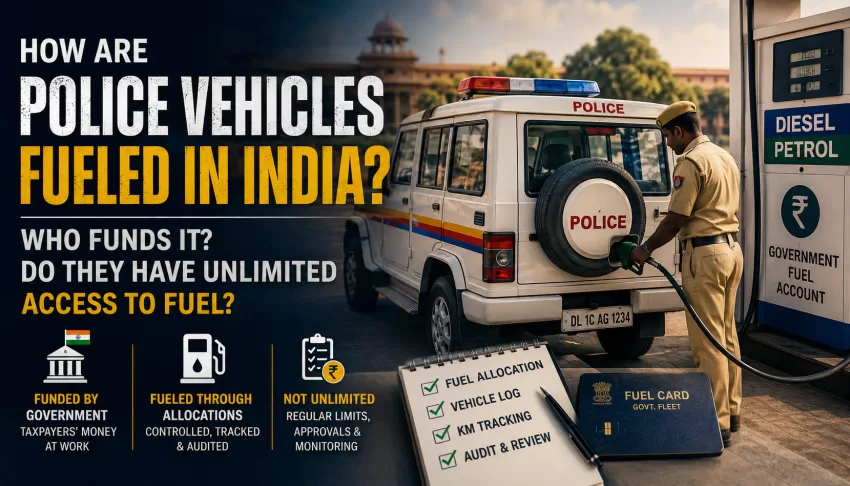
You see a police jeep glide through traffic at 2 AM, siren slicing the night like a hot knife through monsoon fog. A natural question pops up:
Who pays for all this fuel?
And more importantly…
Can police vehicles just fill up unlimited petrol or diesel whenever they want?
The answer is more bureaucratic than cinematic. 🚓⛽
The Simple Answer
Police vehicles in India are fueled using government funds, mainly from:
- State government budgets
- Police department operational expenses
- Special central grants (in some cases)
- District-level allocations
And no, police vehicles do not have unlimited fuel access. Every litre is usually tracked, approved, recorded, and audited.
The fuel system is less “Fast & Furious” and more “Excel sheet with signatures.”
Who Actually Funds Police Vehicle Fuel in India?
In India, policing is primarily a State subject under the Constitution.
That means:
- Delhi Police → funded by Central Government (special case)
- UP Police → funded by Uttar Pradesh Government
- Maharashtra Police → funded by Maharashtra Government
- Uttarakhand Police → funded by Uttarakhand Government
The money comes from taxpayer-funded state budgets approved every financial year.
How the Fuel System Usually Works
Most police departments follow one of these models:
1. Fuel Coupons / Fuel Cards
This is the most common system today.
Police stations or departments receive:
- Fuel cards
- Monthly fuel quotas
- Tie-ups with specific petrol pumps
An officer cannot simply roll into any pump and say:
“Bhar do. Government ka hai.”
There is usually:
- Vehicle number tracking
- Driver logbook
- Kilometer records
- Monthly consumption limits
Think of it like a corporate fleet account, except the vehicles occasionally chase criminals instead of airport pickups.
2. Monthly Fuel Allocation
Each police vehicle may have a sanctioned fuel limit such as:
| Vehicle Type | Approx Monthly Allocation |
|---|---|
| Police bike | Limited litres/month |
| Patrol jeep | Higher allocation |
| Highway interceptor | Much higher |
| VIP escort vehicle | Special category |
The exact quantity varies by:
- State
- District
- Vehicle role
- Crime level in area
- Urban vs rural deployment
A police station in remote Uttarakhand terrain may consume fuel differently from one in central Mumbai traffic where engines idle longer than political debates.
3. Emergency Overrides
In emergencies:
- Riots
- Elections
- VIP movement
- Disaster response
- Terror incidents
- Search operations
Fuel limits may be temporarily relaxed.
Additional fuel expenses can later be reimbursed or specially sanctioned.
Because during a flood rescue, nobody pauses to ask:
“Sir, remaining diesel balance kitna hai?”
Do Police Officers Pay from Their Own Pocket?
Sometimes, yes.
Especially in:
- Underfunded rural stations
- Temporary emergencies
- Delayed reimbursements
There have been reports across India where officers informally paid for:
- Minor fuel expenses
- Vehicle repairs
- Emergency mobility
Though officially, operational fuel should be government-funded.
This gap between policy and ground reality is one of those classic Indian administrative paradoxes:
the paperwork says “fully allocated,” while the constable quietly pays ₹300 for diesel so the patrol can continue.
Are Fuel Expenses Monitored?
Very much.
Fuel usage is often checked through:
- Vehicle logbooks
- Odometer readings
- Duty registers
- Fuel slips
- Digital fleet systems
- Internal audits
Suspiciously high fuel usage can trigger inquiries.
For example:
- Low kilometers + high fuel bills
- Personal usage allegations
- Ghost fueling scams
- Duplicate entries
Yes, fuel corruption investigations do happen.
Sometimes the real crime thriller is inside the maintenance register. 📒
What About Police Gypsies and PCR Vans?
Vehicles like:
- PCR vans
- Highway patrol SUVs
- Riot control vehicles
- Prison vans
- Traffic police interceptors
usually receive higher operational priority.
These are considered essential mobility assets and often get:
- Faster approvals
- Dedicated fueling arrangements
- Priority maintenance
A stranded PCR van is not exactly ideal for public confidence.
Can Police Get Free Fuel Anywhere?
Not officially.
A police vehicle generally cannot demand free fuel from private petrol pumps without authorized billing systems.
Petrol pumps only provide fuel if:
- Government billing exists
- Coupons/cards are valid
- Accounts are approved
Any unofficial pressure for free fuel would be misuse of authority.
What Happens to Seized Vehicles?
Interesting side note.
Vehicles seized in crimes are:
- Stored in police custody
- Usually not used operationally
- Sometimes deteriorate in open lots for years
Contrary to movie mythology, police generally cannot casually use confiscated bikes for patrol duty.
Reality has more paperwork and fewer slow-motion scenes.
The Rise of GPS and Digital Tracking
Many states are modernizing police fleets with:
- GPS tracking
- Digital fuel management
- Automated trip logs
- Fleet analytics
This helps reduce:
- Fuel leakage
- Unauthorized usage
- Fake billing
India’s police vehicle ecosystem is slowly evolving from handwritten diesel diaries into dashboard-driven fleet management.
Slowly. Very slowly.
Like government Wi-Fi during rain.
Final Thought
Police fuel in India is not an “unlimited free petrol” system.
It is:
- Budgeted
- Controlled
- Audited
- Often stretched thin
Behind every patrol vehicle is a chain of:
- taxpayers,
- state budgets,
- departmental approvals,
- fuel logs,
- and administrative machinery.
The flashing beacon may look dramatic on the road, but somewhere in a dusty office, a clerk is probably reconciling diesel entries with a calculator older than the Constitution. 🚓📑